30 Minute Ab Workout at Home: 5 Powerful Proven Routines 2025
Core Strength on Your Schedule
30 minute ab workout at home is the perfect solution for busy moms who want to strengthen their core without leaving the house or investing in expensive equipment. If you’re looking for an effective way to sculpt your midsection, here’s a quick overview:
Quick 30-Minute Ab Workout Summary:
– Time Required: 30 minutes total
– Equipment Needed: None (just your bodyweight)
– Calories Burned: 170-295 calories per session
– Frequency: 3 times per week for optimal results
– Format: Circuit-style with 30-second work periods, 30-second rest periods
A strong core does more than just create a toned midsection – it’s the foundation for better posture, reduced back pain, and improved everyday functionality. Whether you’re picking up your toddler, carrying groceries, or simply sitting at your desk, your core muscles are constantly at work.
The beauty of a 30-minute ab workout is its efficiency. Research shows that short, focused core sessions can be just as effective as longer workouts when done consistently. As one fitness expert noted in our research, “There’s no need to complicate things – simple exercises targeting upper, lower, and oblique abs are sufficient to build strength.”
I’m Amanda Schmitt, a former Occupational Therapist with over 13 years of clinical experience who has personally used 30 minute ab workout at home routines to maintain core strength while balancing life as a mom of two young daughters. My background in rehabilitation has taught me the importance of proper form and targeted exercises for lasting results.
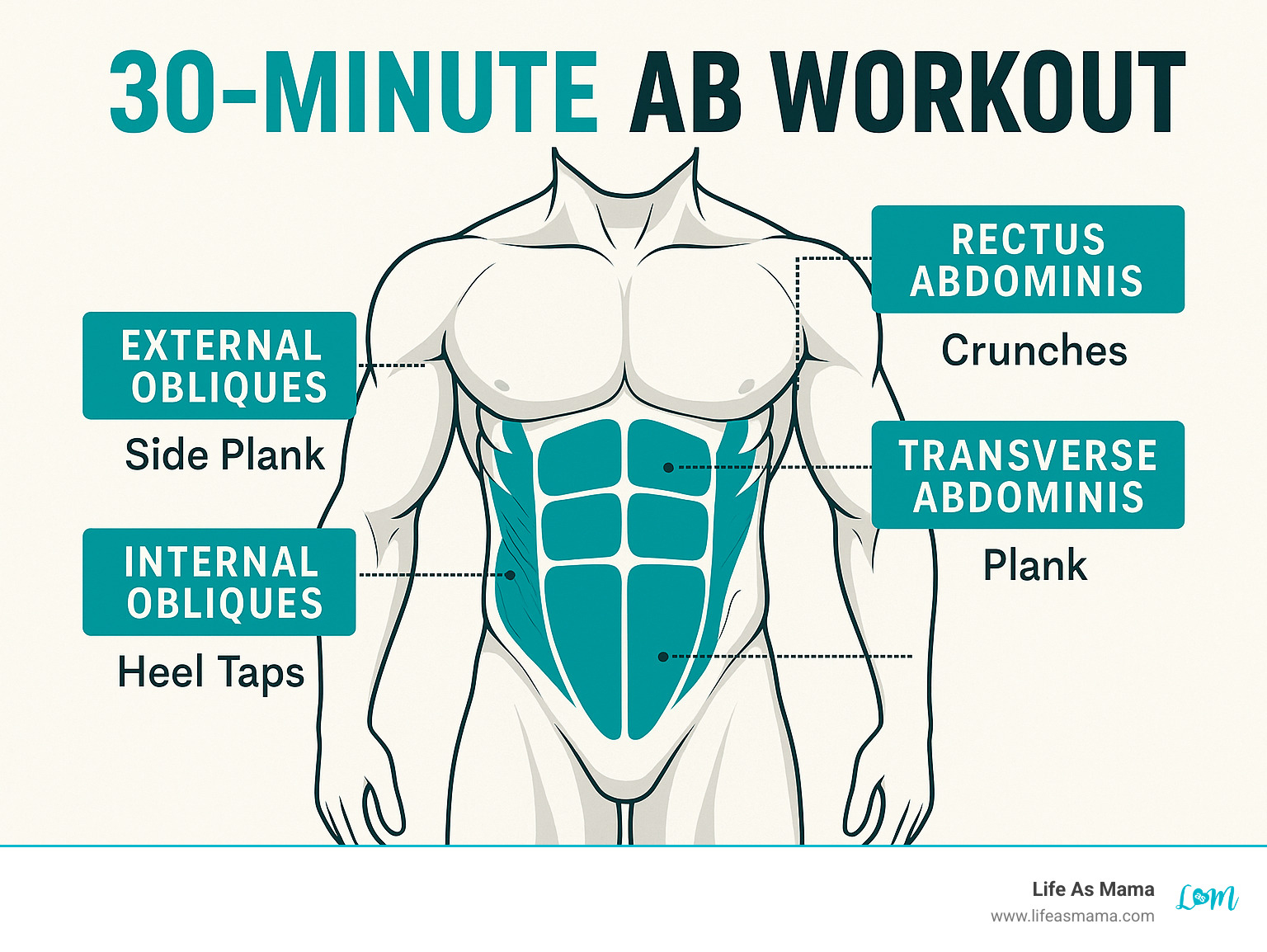
30 minute ab workout at home terms explained:
– 3 best ab exercises at home
– At home bodyweight exercises
– 30 minute workout at home
Why a Strong Core Is Your Secret Weapon
Let’s talk about your core—and I don’t just mean those abs you might want to show off at the pool this summer. Your core is literally the command center for almost every move you make throughout your day. As a mom, this becomes even more crucial!
Injury Prevention
Think about how many times you bend down to pick up toys scattered across the living room floor or lift your little one for a cuddle. A strong core works like a natural back brace, supporting your spine during these movements. I’ve seen it firsthand—parents with stronger core muscles experience significantly fewer back injuries and recover faster when they do have strains. Your body will thank you every time you scoop up your toddler without that telltale lower back twinge!
Posture Boost
Between checking phones for school updates, working at computers, and the general forward-leaning posture of parenting, our spines take a beating. A strong core helps maintain proper alignment, fighting against what some call “mom posture”—that rounded shoulder, forward head position we often find ourselves in after hours of holding babies or hunching over to help with homework. Better posture doesn’t just look more confident—it prevents chronic pain from developing in the first place.
Everyday Strength
Have you noticed how some days even folding laundry feels like a workout? That’s your core at work! When strengthened properly, your midsection muscles make everyday tasks significantly easier—whether you’re vacuuming under furniture, carrying groceries while balancing a child on your hip, or simply getting up from the floor after playtime. 30 minute ab workout at home routines build functional strength that translates directly to easier daily living.
Metabolic Support
Here’s a bonus many people don’t realize—core workouts, especially when structured in a circuit format like our routine, can significantly boost your metabolism. Depending on your intensity and body composition, a 30 minute ab workout at home can burn between 170-295 calories. But even better, strengthening these central muscles supports overall metabolic health long after your workout ends.
According to scientific research on spinal flexion, properly executed core exercises that include controlled movements (like mindful crunches) benefit most people when done with proper form. The key isn’t avoiding certain movements entirely—it’s about variety, technique, and listening to your body.
Your core truly is your secret weapon for navigating the physical demands of family life with more ease and less pain. For more strategies to build strength that supports your overall wellness journey, check out our Five Tips to Better Help You Reach Your Fitness Goals.
Prep & Perfect Form Before You Hit “Start”
Ready to tackle your 30 minute ab workout at home? Hold up just a moment! A little preparation goes a long way toward making your workout both safe and effective. Think of this prep time as an investment in better results and a happier body tomorrow.
Dynamic Warm-Up
Your muscles are like taffy—they work better when they’re warm! Spend 3-5 minutes waking up your body with movement that gradually increases your heart rate and prepares your muscles for action. A proper warm-up isn’t just a formality—it’s your insurance policy against pulled muscles and poor performance.
Try this simple sequence: March in place with high knees for 30 seconds (get those legs moving!), follow with torso twists while extending your arms for another 30 seconds (hello, obliques!), then loosen those hips with gentle circles in both directions for 15 seconds each way. Finish with 30 seconds of light jumping jacks or step-outs if jumping isn’t your thing.

Core Engagement Cue
Here’s a secret many people miss: simply going through the motions isn’t enough. The magic happens when you properly engage your core. My favorite cue that I share with all my clients? “Brace as if you’re about to take a punch to the stomach.” This creates that 360-degree tension around your midsection that both protects your spine and ensures you’re working the right muscles.
When you get this right, you’ll feel a gentle tightening through your entire midsection—not just the front “six-pack” area, but wrapping around your sides and supporting your back too.
Tailbone Tuck
When you’re lying on your back for floor exercises, there’s often a gap between your lower back and the mat. This arch can lead to strain and discomfort. The fix? Gently tuck your tailbone under slightly to press your lower back toward the floor. This small adjustment makes a world of difference—it instantly activates those stubborn lower abs and takes pressure off your spine.
Lower-Back Safety
Your lower back is sending you important signals—listen to them! If you feel any pinching or pain (not to be confused with the “burn” of working muscles), stop immediately. This usually means either your core isn’t properly engaged or you’ve chosen an exercise that’s currently too challenging for your fitness level.
No shame in modifying! Skip to another exercise or try the beginner versions we’ll cover later. Your back will thank you, and you’ll still get great results.
Knee-Friendly Options
Knees talking back during certain exercises? You’re not alone. For knee comfort during moves like mountain climbers, simply place a folded towel under your knees for cushioning. If that’s not enough, the modified versions in our beginner section were designed with joint protection in mind.
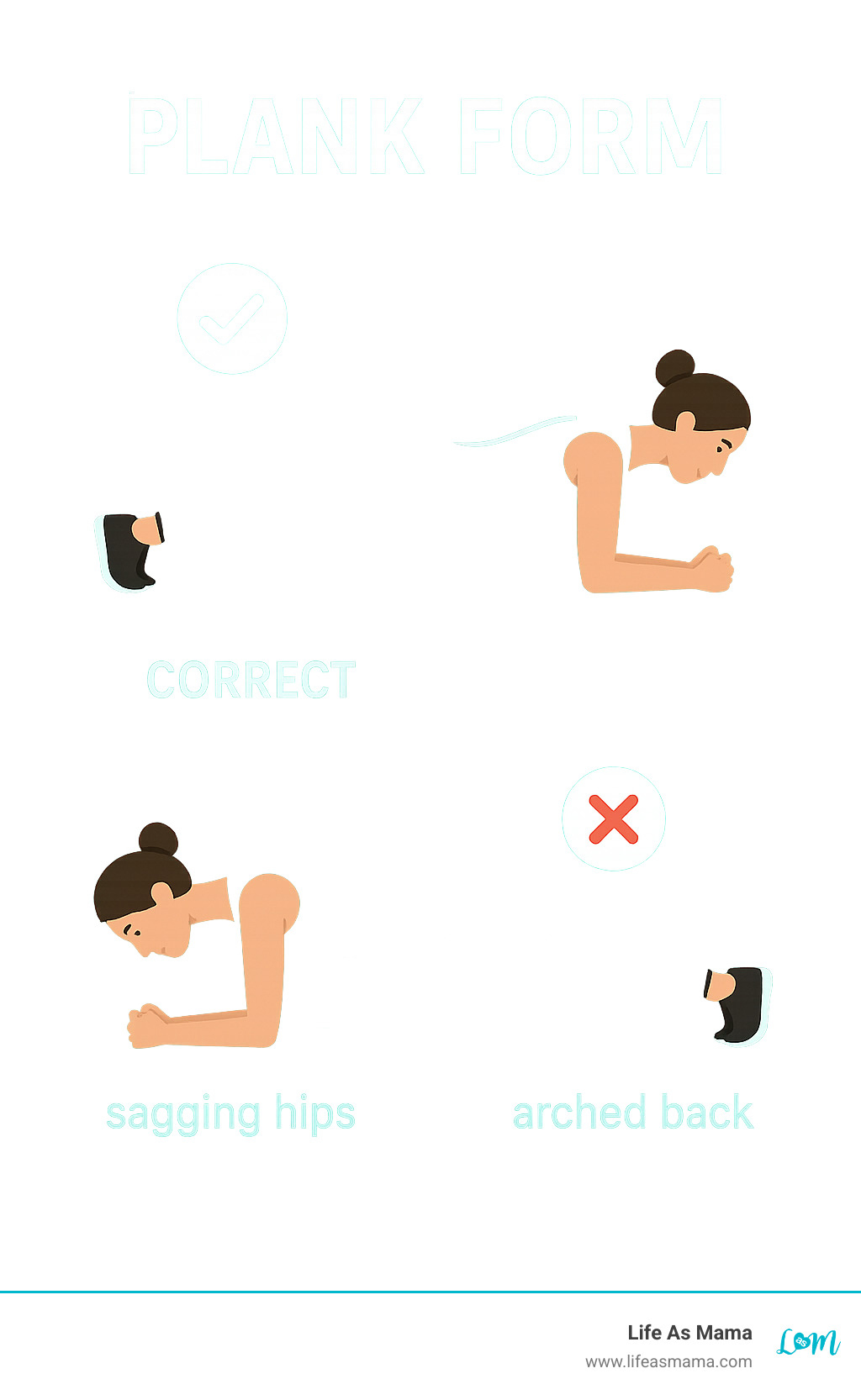
Perfect form might not be Instagram-worthy at first (hello, wobbly planks!), but it’s what keeps you injury-free and making progress. The infographic above shows the dramatic difference between correct and incorrect plank position—notice how proper form creates a straight line from head to heels.
For more detailed guidance on the most effective exercises you can do right in your living room, check out our 3 Best Ab Exercises at Home article. These moves form the foundation of any great home core routine.
Taking these few minutes to set up properly isn’t wasted time—it’s the difference between a workout that delivers results and one that leaves you frustrated or injured. Your body deserves this care!
30 Minute Ab Workout at Home: Follow-Along Routine
Ready to transform your core? Let’s explore our complete 30 minute ab workout at home that targets all the essential muscle groups: your rectus abdominis (the “six-pack” muscles), transverse abdominis (your deep stabilizers), and those important internal and external obliques that define your waistline.
Circuit Layout
I’ve designed this workout as a circuit to give you the most bang for your buck. Here’s how it works:
You’ll move through 5 powerful core exercises with 30 seconds of work followed by 30 seconds of rest. After completing all five moves, you’ll take a well-deserved 90-second breather before starting again. Aim for 3-5 complete rounds depending on your fitness level, and if you’re feeling particularly ambitious, finish with up to 100 sit-ups (or whatever number feels challenging but doable for you).
This format is magical because it keeps your heart pumping for metabolic benefits while giving your muscles just enough recovery to maintain proper form throughout.
Want more comprehensive home workout options? Check out our complete 30 Minute Workout at Home guide for full-body routines.
Warm-Up (5 Minutes)
Never skip this crucial prep phase! These three simple movements will wake up your core and prepare your body:
March-in-Place (2 minutes)
Stand tall with your feet hip-width apart and simply march in place, gradually bringing your knees higher toward your chest. Let your arms swing naturally as you slowly increase both height and speed. This gentle cardio wakes up your whole body.
Toe-Touch Sweeps (1.5 minutes)
Stand with feet wider than shoulder-width and reach down to touch your right foot with your left hand while extending your right arm up toward the ceiling. Return to center and repeat on the opposite side. The gentle rotation begins activating those important oblique muscles.
Cat-Cow (1.5 minutes)
Come to hands and knees in a tabletop position. As you inhale, drop your belly toward the floor and look up (cow pose). Then exhale as you round your spine toward the ceiling while tucking your chin (cat pose). This gentle spinal movement prepares your back for the work ahead.
Classic Core Circuit
Now for the main event! Remember: 30 seconds of work, 30 seconds of rest between each exercise.
Mountain Climber
Start in a high plank position with shoulders stacked over wrists. Drive one knee toward your chest, then quickly switch legs as if you’re running in place. The key is keeping your hips stable and core engaged—no bouncing or sagging in the middle! Move at a pace that challenges you but still allows good form.
Lateral Plank Walk
Begin in high plank position, then simultaneously step your right hand and right foot out to the side. Follow with your left hand and left foot to return to your plank. Continue “walking” sideways for 15 seconds, then reverse direction. This move sneakily works your shoulders while firing up those side abs.
Leg Lift
Lie on your back with legs extended and hands tucked under your lower back for support. Press your lower back into the floor as you lift your legs to 90 degrees, then lower them to hover about 6 inches off the ground. The slower and more controlled you move, the more your lower abs will thank you (tomorrow, that is!).
Flutter Kick
Remain on your back with hands under your glutes or at your sides. Lift your head and shoulders slightly off the ground (think mini-crunch position) and raise your legs 6-12 inches. Create small, rapid alternating kicks as if you’re swimming. Keep that core engaged to protect your lower back from strain.
Breakdancer
Start in a high plank position, then rotate your hips to bring your right knee toward your left elbow. Return to plank, then bring your left knee toward your right elbow. This cross-body movement is fantastic for your obliques and adds a fun, dynamic element to your workout.
After completing all five exercises, take that 90-second rest before diving into your next round. Your body needs this recovery to maintain proper form in subsequent rounds!
Beginner-Friendly 30 Minute Ab Workout at Home
New to core training? Don’t worry! These modifications will help you build strength safely while still getting amazing results:
Reduced Range of Motion options include keeping a smaller arc during leg lifts (only lifting to 45 degrees), keeping your legs higher during flutter kicks, and simplifying the breakdancer by bringing your knee toward the same-side elbow instead of crossing over.
Bent-Knee Versions make exercises more manageable—try leg lifts with bent knees, slower-paced mountain climbers, or planks from your knees instead of toes.
Lifted Planks using a sturdy coffee table or couch create an incline that reduces the load on your core while you build strength. As you get stronger, gradually lower the incline until you’re ready for floor work.
Remember this fitness truth: it’s always better to do a modified version with perfect form than to struggle through the full version with poor form. Your results (and your back) will thank you!
Advanced 30 Minute Ab Workout at Home
Ready for more intensity? After mastering the classic circuit, challenge yourself with these advanced variations:
Star Plank
Begin in a forearm plank position, then extend your right arm forward and left leg back simultaneously. Hold for 2-3 seconds to really feel that core stabilization, then return to plank. Repeat with your left arm and right leg, continuing to alternate sides. This move challenges your balance and full-body stability.
Hanging Knee Raise Alternating
If you have a pull-up bar or sturdy door frame bar, this move is gold for your abs. Hang with arms fully extended, engage your core, and lift your knees toward your chest. Lower with control, then repeat. For an extra challenge, twist your knees toward alternating elbows to fire up those obliques.
Weighted Russian Twist
Sit on the floor with knees bent and feet lifted slightly. Hold a household object (water bottle, book, or small child—kidding on that last one!) and lean back slightly to engage your core. Rotate your torso to touch the weight to the floor on each side while keeping your chest lifted. The added resistance takes this classic move to new levels.
Cool-Down & Mobility (5 Minutes)
Never skip this important recovery phase! These gentle stretches will help prevent soreness and improve flexibility:
Child’s Pose (1.5 minutes)
Kneel on the floor with your big toes touching and knees apart. Sit back on your heels and extend your arms forward, resting your forehead on the mat. Breathe deeply into your back and shoulders, feeling the gentle release after all that hard work.
Cobra Stretch (1.5 minutes)
Lie face down with hands under your shoulders. Press gently into your hands to lift your chest while keeping your hips on the floor. Maintain a slight bend in your elbows to avoid strain. Hold for 30 seconds, release, and repeat to counterbalance all those forward-flexing movements.
Hip Flexor Release (2 minutes)
Kneel with your right foot forward in a lunge position, keeping your right knee over your ankle and left knee on the floor. Gently press your hips forward until you feel a stretch in the front of your left hip. Hold for one minute (yes, a full minute!), then switch sides. This stretch is crucial after all those leg lifts and flutter kicks.
Your 30 minute ab workout at home is now complete! Consistent practice of this routine 3 times weekly, combined with proper nutrition, will strengthen your core from the inside out—creating not just a more sculpted appearance but a more functional, pain-free body for all your daily activities.
Programming, Frequency & Progress Tracking
Making the most of your 30 minute ab workout at home isn’t just about pushing through the exercises—it’s about smart planning and tracking your journey. Let’s talk about how to structure your routine for real, visible results.
The 3x Per Week Rule
Your abs are muscles that need both challenge and recovery to grow stronger. Research consistently shows that training your core three times weekly hits that sweet spot for most people. It’s enough stimulus to build strength without overtraining. Here’s how your week might look:
- Monday: Full 30 minute ab workout at home
- Tuesday: Rest day or focus on other activities like walking or upper body
- Wednesday: Back to your core routine
- Thursday: Another recovery day
- Friday: Final ab session of the week
- Weekend: Give those abs a break with gentle movement like family walks or light stretching
I’ve found this rhythm works wonderfully for busy parents—it’s consistent enough to see progress but flexible enough to fit into unpredictable family schedules.
Rest-Day Recovery
Remember this truth: your muscles don’t actually grow during workouts—they grow while you rest. During those off days, your body repairs tiny tears in muscle fibers, rebuilding them stronger than before. Think of rest as an active part of your fitness plan, not just something you do when you’re too busy for a workout.
Many of us (myself included!) have made the mistake of thinking “more is better” when it comes to ab training. But without proper recovery between sessions, you might actually reverse your progress and increase injury risk. Your body needs that downtime—accept it!
Progressive Overload
Our bodies are remarkably adaptable. The workout that challenges you today will feel easier in a few weeks as your strength improves. This is wonderful progress, but it also means you need to gradually increase difficulty to continue seeing results.
You can create progressive overload in several ways:
Add an extra circuit (work up from 3 to 4 or 5 rounds), decrease your rest periods (try 25 or 20 seconds instead of 30), incorporate those advanced variations we discussed earlier, or add light weights to exercises like Russian twists. Even holding a water bottle can increase the challenge!
The key is making small, manageable increases rather than dramatic jumps that might compromise your form.
Rep Log
There’s something incredibly motivating about seeing your progress in black and white. A simple notebook or phone app can become your fitness ally by tracking:
Workout date – Helps you maintain consistency
Circuits completed – Watch this number grow over time
Modifications used – See how you’re gradually needing fewer adaptations
How you felt – Notice patterns in energy and performance
Next-time goals – Set small, achievable targets for each session
I started keeping a fitness journal when my second daughter was born, and looking back at those early entries reminds me how far I’ve come—from struggling through a single circuit to confidently completing advanced variations.
| Aspect | Beginner | Intermediate | Advanced |
|---|---|---|---|
| Circuits | 2-3 | 3-4 | 4-5 |
| Work/Rest | 30s/30s | 30s/20s | 40s/20s |
| Frequency | 2-3x/week | 3x/week | 3-4x/week |
| Recovery | 48 hours | 24-48 hours | 24 hours |
Wherever you fall on this spectrum, consistency trumps intensity every time. A gentle workout you actually complete is infinitely more effective than an intense one you skip because it feels overwhelming.
For more comprehensive guidance on setting realistic fitness goals and tracking your progress, check out our Five Tips to Better Help You Reach Your Fitness Goals. You’ll find practical advice that works especially well for busy parents juggling multiple responsibilities.
Nutrition & Lifestyle for Visible Abs
Let’s have a heart-to-heart talk about something important: your 30 minute ab workout at home routine is fantastic, but it’s only part of the equation for seeing those core muscles. As moms, we deserve honesty – and the truth is that what happens in the kitchen matters just as much as what happens on your exercise mat.
Calorie Deficit
Think of your body fat like a curtain covering your abdominal muscles. To pull back that curtain, you’ll need a modest calorie deficit. Don’t worry – this doesn’t mean starving yourself! For most women, it’s about making small, sustainable changes:
Calculate your maintenance calories (there are plenty of user-friendly calculators online), then aim for 300-500 fewer calories daily. Focus on nutrient-rich whole foods rather than just eating less. This is about nourishing your body while working toward your goals.
Protein Intake
Protein is your best friend when you’re working on core definition. It helps preserve the muscle you’re building while your body sheds fat. Aim for 1.2-1.6 grams per kilogram of body weight daily – for a 150-pound woman, that’s roughly 82-109 grams.
Your body will thank you for including lean meats, eggs, Greek yogurt, legumes, and even the occasional protein smoothie. As busy moms, protein-rich snacks like cottage cheese with fruit or hard-boiled eggs can be lifesavers when hunger strikes between meals.
Hydration
Water is magical for your metabolism and muscle definition. When you’re dehydrated, your body holds onto water (ironically!), which can mask the results of your hard work. Aim for 8-10 cups daily, more if you’re sweating through your 30 minute ab workout at home or chasing toddlers in summer heat.
A simple trick I love: keep a water bottle within arm’s reach throughout the day. You’ll be surprised how much more you drink when it’s right there in front of you.
Sleep Quality
As moms, we often sacrifice sleep for everything else on our to-do lists. But those 7-9 hours are crucial for seeing results from your ab workouts. When you’re sleep-deprived, your body produces more cortisol (stress hormone) and ghrelin (hunger hormone), while reducing leptin (which tells you you’re full).
Even one extra hour of sleep can make a difference in your body’s ability to recover and reveal those core muscles you’re working so hard to strengthen.
Stress Management
Our bodies weren’t designed to handle the constant stress of modern life – especially mom life! When stress becomes chronic, cortisol levels stay liftd, and that hormone loves to store fat around your midsection (exactly where you’re trying to tone up).
Find small moments for yourself throughout the day. Five minutes of deep breathing, a quick walk outside, journaling while your coffee brews, or simply setting a technology boundary after dinner can help lower those cortisol levels. Your mind and your midsection will both benefit.
Being kind to yourself is part of the journey. Progress in your 30 minute ab workout at home routine combined with these nutrition and lifestyle factors will get you results that last.
For more specific strategies on targeting stubborn belly fat, check out our article on Getting Rid of Belly Flab: Three Techniques That Work.
Frequently Asked Questions about 30-Minute Ab Workouts
How often can I safely train abs?
Just like any muscle group, your core needs time to recover and rebuild after a good 30 minute ab workout at home. While you might be eager to crunch every day, your body has other plans! Most fitness experts recommend training your abs 3-4 times weekly with rest days in between.
On those “off” days when you’re feeling particularly motivated, there’s nothing wrong with a quick 5-10 minute core session. Just be smart about it—focus on different movements than your main workouts to avoid overtraining the same muscle fibers.
Your core gets plenty of indirect work during everyday activities too! Whether you’re squatting to pick up toys, carrying groceries, or even pushing a stroller around the neighborhood, those abs are quietly working in the background, supporting your spine and stabilizing your movements.
Will this give me a six-pack alone?
I’d love to tell you that your 30 minute ab workout at home is the only ticket to visible abs, but I’d be doing you a disservice. The honest truth is that while these workouts will absolutely strengthen and tone your abdominal muscles, seeing them requires reducing the layer of fat that naturally covers them.
Visible abs typically appear when women reach around 18-24% body fat and men around 10-15%. This is why the nutrition and lifestyle factors we discussed earlier are so crucial to your success.
Think of it this way: you’re like a sculptor working on a masterpiece. The workouts are carving beautiful definition underneath, but you’ll need proper nutrition to remove the clay covering your creation. Both elements working together create the result you’re looking for!
How do I avoid lower-back pain during leg raises?
That uncomfortable pinch in your lower back during leg raises is incredibly common, so don’t worry—you’re not alone! This usually happens for one of three reasons, all of which have simple fixes:
First, check if your core is properly engaged before you start moving. Press your lower back firmly into the floor, creating what some trainers call a “back imprint” on the mat. Imagine someone is about to drop a light weight on your stomach, and you’re bracing to protect yourself.
Second, you might be using too large a range of motion. Only lower your legs to the point where you can maintain that back-to-floor contact. Once your back starts to arch, you’ve gone too far!
Third, the exercise might simply be too advanced for your current core strength. There’s absolutely no shame in modifying! Try bending your knees (which shortens the lever and reduces strain), placing your hands under your lower back for support, or switching to gentler movements like marches or dead bugs.
Proper form always trumps completing a certain number of reps. Your body is unique, and listening to its signals is the smartest approach to fitness.
Conclusion
There’s something incredibly satisfying about completing a 30 minute ab workout at home. That final stretch as you cool down, the good kind of muscle fatigue, and knowing you’ve done something positive for your body – all without leaving your living room.
The beauty of this approach is its simplicity and accessibility. No fancy equipment, no complicated routines – just you, your determination, and 30 minutes of focused effort. When done consistently, these short core sessions create meaningful changes both in how you look and how you function in daily life.
Your journey to a stronger core relies on three key pillars:
First, consistency truly is your best friend. Three moderate sessions spread throughout your week will transform your core more effectively than sporadic intense workouts that leave you too sore to continue. The body responds to regular, sustainable challenges – not occasional heroic efforts.
Second, proper form isn’t just a suggestion – it’s essential. Taking the time to engage correctly, move with control, and modify exercises when needed will protect your back and maximize results. Quality always trumps quantity when it comes to core training.
Third, nutrition and lifestyle factors work hand-in-hand with your exercise routine. Even the most perfect 30 minute ab workout at home can’t overcome poor sleep habits, chronic stress, or nutrition that doesn’t support your goals. Your body needs all these elements working together.
I encourage you to track your progress beyond just what you see in the mirror. Notice how picking up your child becomes easier, how your posture improves during long work calls, or how back pain diminishes during household chores. These functional victories often appear before visible changes and are just as worthy of celebration.
Be patient with yourself throughout this process. Visible definition typically takes 4-8 weeks of consistent effort to emerge, but the strength and stability benefits begin immediately. Trust the process and enjoy the journey.
For those looking to incorporate core training into a more comprehensive fitness routine, our 6-Day Home Workout Schedule provides an excellent framework.
At Life As Mama, we understand the delicate balance between caring for your family and caring for yourself. We believe these aren’t competing priorities but complementary ones – a stronger, more energetic you means a more present, capable parent and partner. Your family deserves your best self, and that includes a body that feels good and functions well.
We’d love to hear how this workout fits into your life! Share your experiences, adaptations, or questions in the comments below. Your journey might just inspire another mama to begin hers.
Related Images:

Amanda Schmitt
Latest posts by Amanda Schmitt (see all)
- 20+ First Day of School Traditions to Make the Day Special - August 23, 2026
- Fruit Infused Waters That Make Summer Hydration Fun - July 1, 2025
- Light Up Your Life: Home Lighting Decoration Ideas - June 30, 2025