30 minute workout at home for beginners: 5 Powerful Proven Tips
Making Time for Fitness: The 30-Minute Solution
Let’s be honest—finding time for fitness when you’re juggling work, family, and a million other responsibilities can feel impossible. That’s where a 30 minute workout at home for beginners comes in as your fitness lifeline! I finded this approach myself when my second child arrived and my gym membership collected dust for months. Trust me, half an hour is all you need to transform your health without turning your schedule upside down.
Quick Start Guide: 30 Minute Workout At Home For Beginners
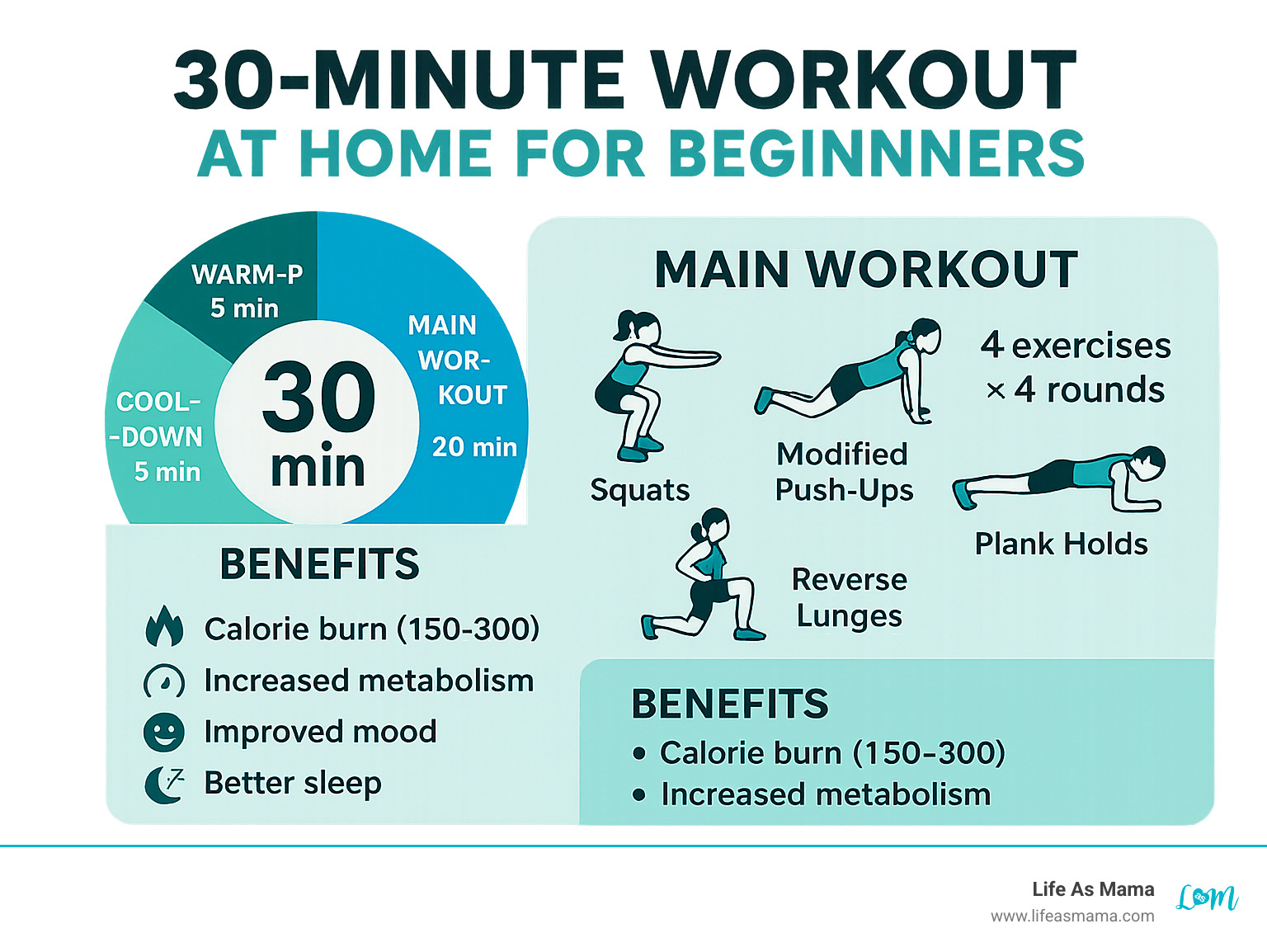
Think of this as your no-frills roadmap to fitness. Begin with a 5-minute warm-up where you’ll march in place, do some arm circles, and perform light squats to wake up your muscles. The 20-minute main workout is where the magic happens—you’ll complete 4 rounds of 4 simple exercises: bodyweight squats (10-15 reps), modified push-ups (8-10 reps), reverse lunges (10 per leg), and plank holds (20-30 seconds). Finish with a 5-minute cool down of gentle stretches to help your body recover and prevent soreness.
Don’t worry about the clock—this flow feels natural once you get started, and you’ll be surprised how quickly the time passes when you’re focused on your movement!
Short workouts pack more punch than most people realize. The American Heart Association recommends 150 minutes of moderate exercise weekly, which means just five of these 30 minute workout at home for beginners sessions meets their guidelines perfectly. These efficient workouts fire up your metabolism, strengthen your heart, and build muscle without overwhelming you when you’re just starting out.
The best part? No fancy equipment required! Your body provides all the resistance you need to start seeing results. As you get stronger (and you will!), a pair of light dumbbells (5-10 lbs) can add just enough challenge to keep you progressing.
As a former Occupational Therapist with over 13 years helping people move better, I’ve designed countless 30 minute workout at home for beginners programs. But it wasn’t until becoming a mom of two that I truly appreciated how these efficient workouts fit into real life. Some days, my “gym” is the living room with toys scattered everywhere and a toddler trying to crawl under my plank position—and that’s perfectly okay!
If you’re looking to mix things up or need more guidance, we’ve got you covered with resources like our 15 minute workout at home for beginners for extra-busy days, at home bodyweight exercises for equipment-free options, and 7 exercises to do everyday at home for daily movement habits.
The workout that works best is the one you’ll actually do—and these 30-minute sessions are designed to fit into your life, not the other way around!
Science-Backed Benefits & Getting Ready
Let’s talk about why that 30 minute workout at home for beginners is such a game-changer! Did you know that a half-hour of moving your body can burn anywhere from 150-400 calories? But honestly, the magic goes way beyond just calorie math.
When you push yourself in those 30 minutes, your body keeps burning calories long after you’ve showered and moved on with your day. Fitness pros call this EPOC (excess post-exercise oxygen consumption), but I just call it amazing! As Lindsey Bomgren, a certified personal trainer I really admire, puts it: “The most effective workout plan is one you’ll actually follow.” That’s why 30 minutes hits the sweet spot—challenging enough to work, brief enough to fit into real life.
The American Heart Association isn’t just guessing when they tell us that consistent movement significantly reduces heart disease risk and boosts overall health. And the beautiful part? You don’t need fancy equipment or a gym membership to reap these rewards.
For your 30 minute workout at home for beginners, you really just need your wonderful body! If you want to level up eventually, a pair of light dumbbells (5-10 pounds) or a resistance band can add some spice, but they’re completely optional.
Before jumping into any workout, please warm up those muscles! Your body deserves that gentle preparation to perform its best and stay injury-free.
For more mom-friendly fitness ideas that actually work with chaotic family schedules, I’ve found our guide to At Home Exercise Tips For Busy Moms incredibly helpful.
Why 30 Minutes Works
I love what fitness expert Matt Young says: “Think you don’t have time to work out? You do. It’s the intensity of your workout that’s key.”
The 30-minute format is practically magical because:
Consistency becomes possible when you’re not trying to block out huge chunks of time. Most of us can find 30 minutes 3-5 times weekly, even with kids, work, and life’s chaos.
You’ll actually stick with it – research shows shorter workouts have higher adherence rates (meaning you won’t quit by February!).
It satisfies the experts – the American Heart Association recommends 150 minutes of moderate activity weekly. Five 30-minute sessions? Mission accomplished!
HIIT makes it mighty – High-intensity interval training packs the punch of much longer workouts into that precious half hour.
I love what Bryant D. Edwards, a certified fitness instructor, notes about setting realistic goals: “Too often people set a goal that sounds good because it’s what society is telling us we should strive for, but in reality it is so far off what we really want for ourselves.” A 30-minute commitment feels doable, not daunting.
Essential Equipment Checklist
While your 30 minute workout at home for beginners needs zero fancy equipment, a few basic items can make the experience more comfortable:
A yoga mat creates your little fitness zone and cushions your joints during floor work. A sturdy chair or bench provides support for modified moves when you need it. Keep a water bottle nearby because hydration matters! And a timer or smartphone app helps you track intervals without clock-watching.
As strength coach Brooke Mathe wisely says, “You can do so much with body weight and stuff you have in your house. And you can absolutely get an amazing workout in.”
If you’re thinking about adding weights, start light! Most beginners do wonderfully with 5-10 pound dumbbells. And here’s my mom-hack: filled water bottles or canned goods work perfectly until you’re ready to invest in actual weights.
5-Minute Warm-Up Flow
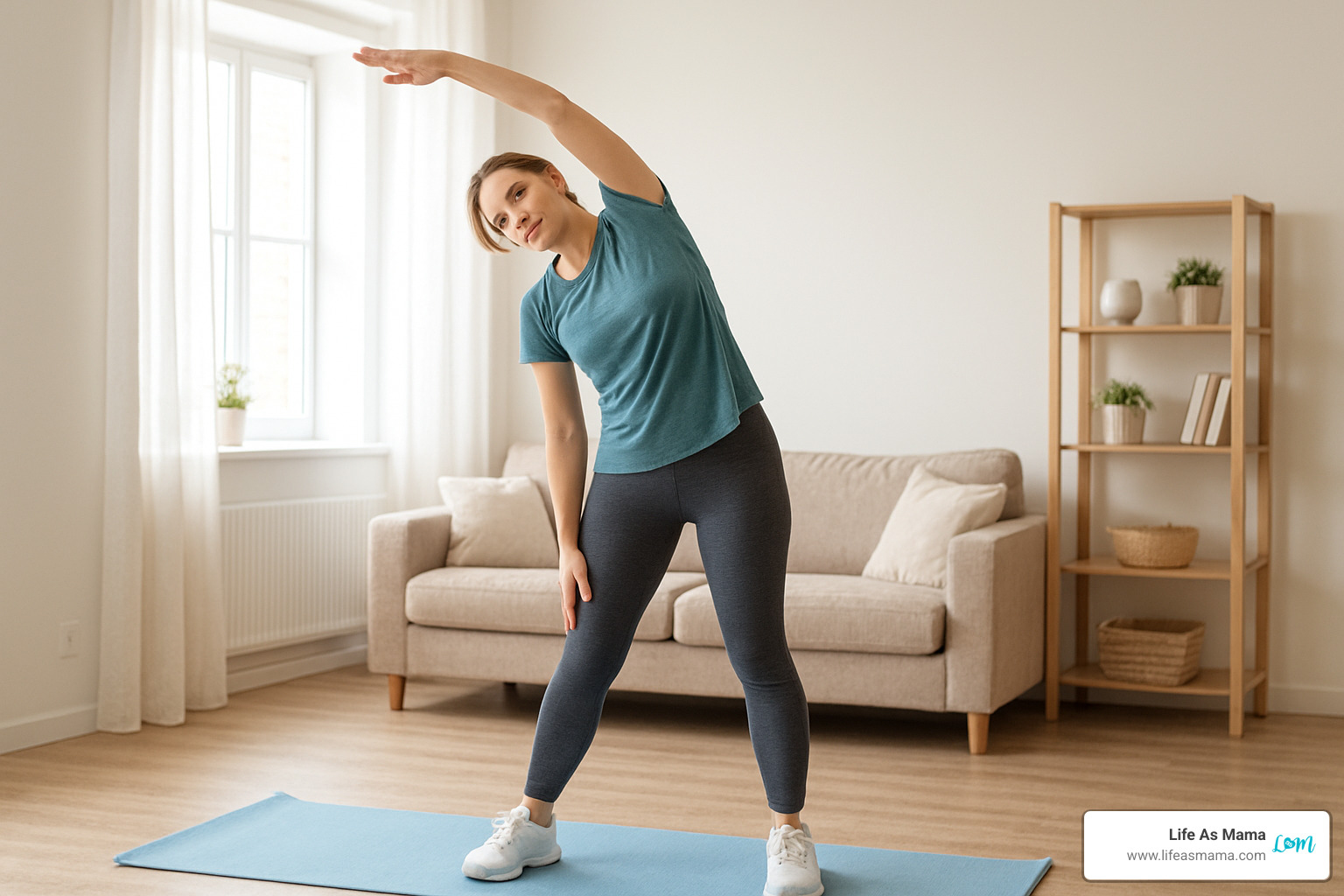
Please don’t skip warming up! Those five minutes increase blood flow to your muscles, loosen up stiff joints, and mentally prepare you for what’s ahead. Try this simple flow:
Start with marching in place for 60 seconds, swinging your arms naturally. Your heart rate will gently rise as your body wakes up.
Follow with arm circles for 30 seconds – small forward circles that gradually grow larger, then reverse direction for the final 15 seconds.
Next, do hip openers for 60 seconds (30 seconds each side). Standing on one leg (holding a wall for balance if needed), draw circles with your knee to loosen those hips.
The inchworm is next for 60 seconds: from standing, hinge at your hips, place hands on the floor, walk them forward to a plank, then walk them back and stand up. This warms your entire body!
Finish with light squats for 60 seconds – about 10-15 gentle squats focusing on form rather than depth. Keep weight in your heels and chest lifted.
As fitness expert Anna Victoria says, “It’s low-impact and suitable for beginners of all ages.” Perfect for easing into that 30 minute workout at home for beginners that’s about to change your day!
30-Minute Workout at Home for Beginners
Ready to get moving? Let’s explore the heart of your 30 minute workout at home for beginners! I’ve designed this circuit to be both simple and effective, combining strength and cardio elements that work together to maximize your results without overwhelming you.
What I love most about this workout is how functional it is. You’ll be performing movements that target multiple muscle groups at once, which not only saves time but also improves strength, endurance, and mobility that translate directly to everyday activities—like lifting your toddler or carrying groceries without getting winded!
Circuit Overview: 30 Minute Workout At Home For Beginners
Your workout follows a straightforward structure that anyone can follow:
- Format: You’ll move through exercises back-to-back (circuit style)
- Work intervals: Each exercise lasts 40 seconds (just focus on form, not speed!)
- Rest intervals: Take a quick 20-second breather between exercises
- Rounds: You’ll complete the circuit 4 times total
- Set breaks: Enjoy a well-deserved 90-second rest between full rounds
This format gives you about 20 minutes of actual exercise time, plus your 5-minute warm-up and 5-minute cool-down to complete your perfect 30-minute session.
As a beginner, your primary focus should be on form rather than speed or counting reps. During each 40-second interval, aim for quality movements within this general range:
| Exercise Type | Beginner Reps | Intermediate Reps |
|---|---|---|
| Bodyweight Squats | 8-12 | 15-20 |
| Modified Push-ups | 6-10 | 12-15 |
| Reverse Lunges | 6-8 per leg | 10-12 per leg |
| Plank Holds | 20-30 seconds | 40 seconds |
| Core Exercises | 8-12 | 15-20 |
To gauge your effort level, use the Rate of Perceived Exertion (RPE) scale. Think of it as a 1-10 intensity meter where RPE 7-8 is your sweet spot—challenging but something you can maintain throughout the workout. At this level, you should be able to speak in short sentences, but not carry on a comfortable conversation.
Full-Body Flow: 30 Minute Workout at Home for Beginners
Here’s your complete exercise sequence. I’ve included beginner-friendly tips for each move because we all start somewhere!
1. Bodyweight Squats (40 seconds)
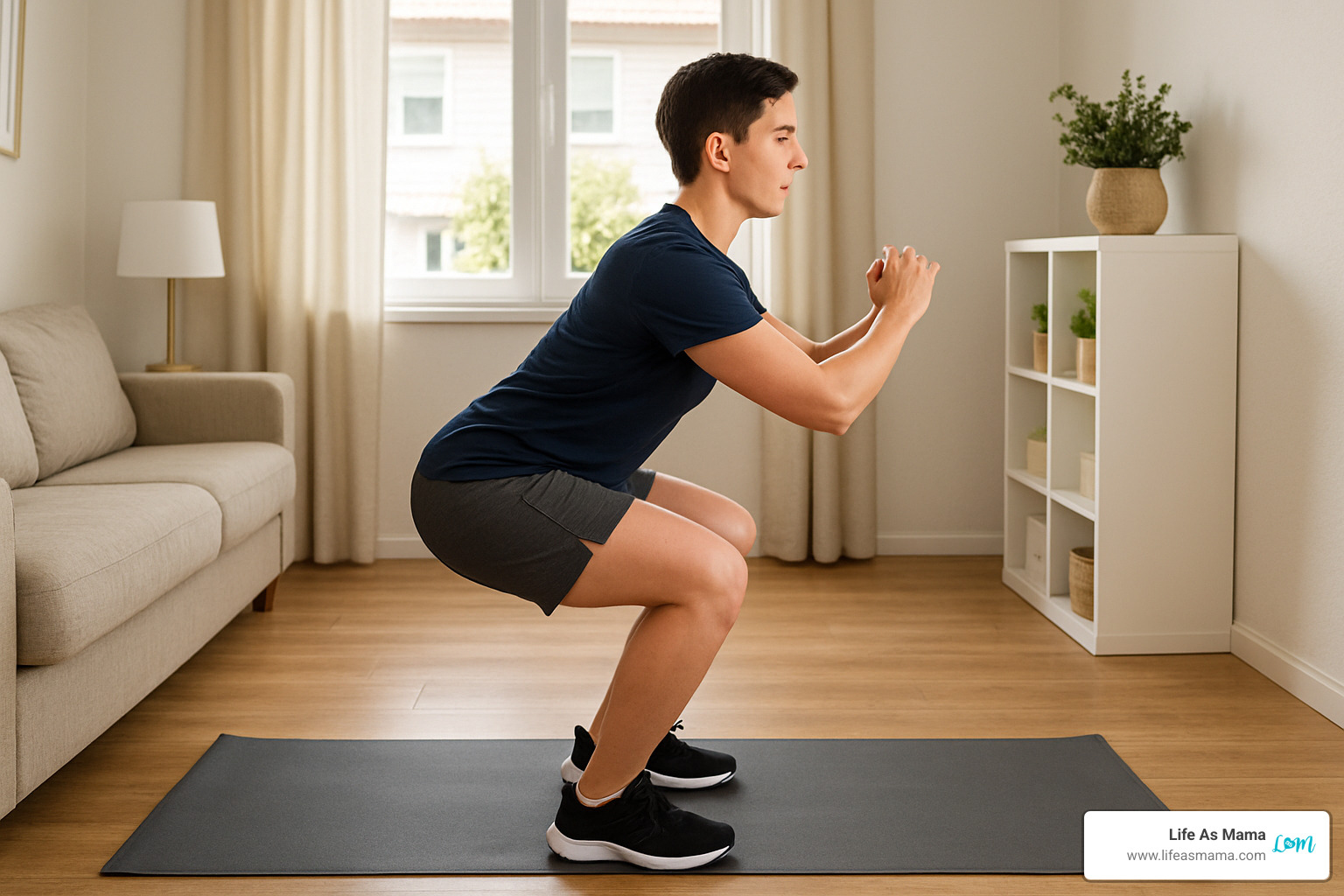
Stand with feet shoulder-width apart and send your hips back and down like you’re sitting in an invisible chair. Keep your chest lifted and weight in your heels, then push through those heels to stand back up. If you’re unsure about depth, try positioning an actual chair behind you—just tap it lightly with your bottom without fully sitting.
2. Modified Push-ups (40 seconds)
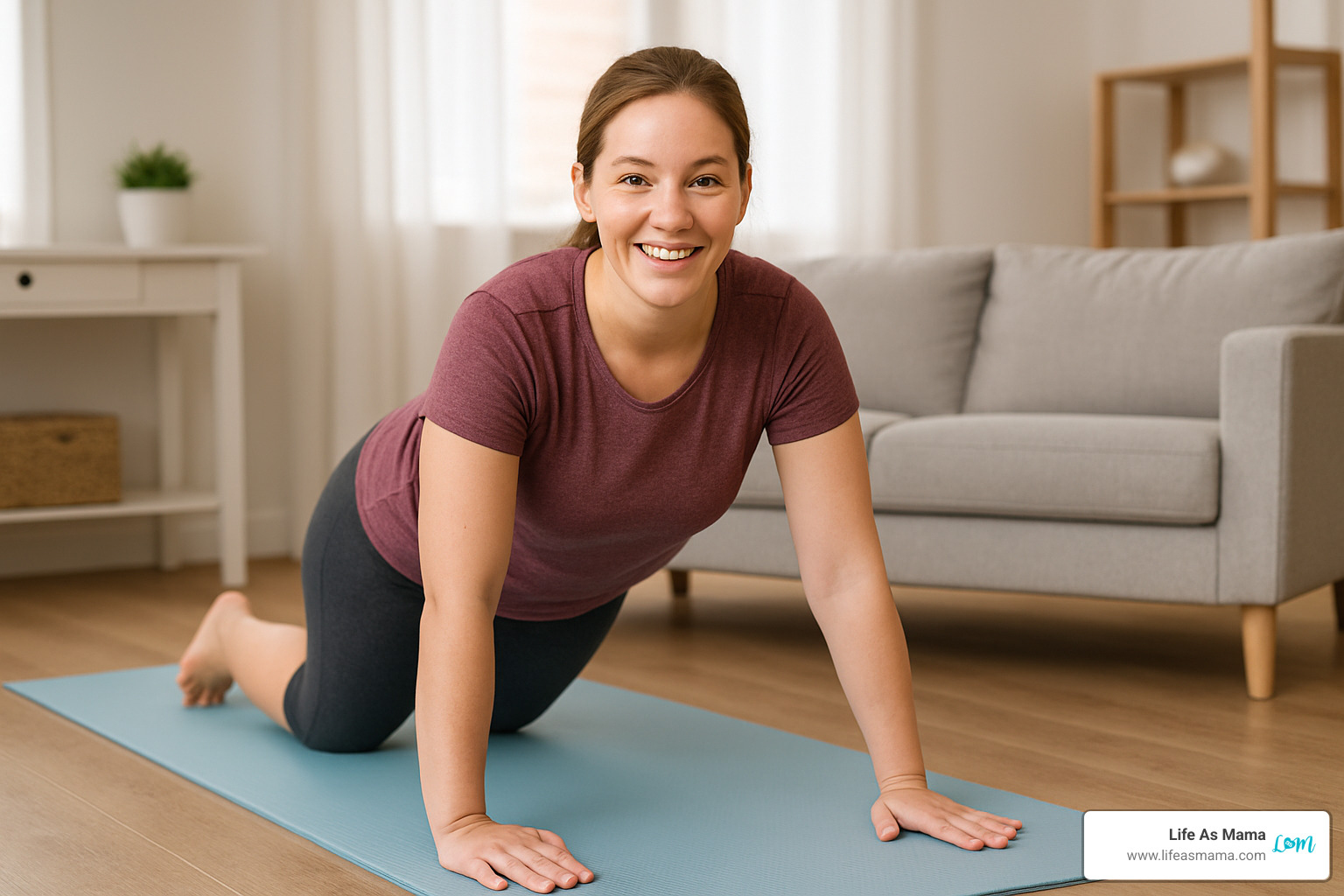
Start on your knees with hands slightly wider than shoulders. Keep your body in a straight line from knees to head (no sagging in the middle!). Lower your chest toward the floor with elbows at a 45° angle, then push back up. Too challenging? No problem! Start with push-ups against a wall or countertop and progress from there.
3. Reverse Lunges (40 seconds)
From a standing position, step one foot backward and lower your knee toward the floor. Your front knee should stay aligned over your ankle (not pushing past your toes). Push through your front heel to return to standing, then alternate legs. If balance is tricky, hold onto a sturdy chair with one hand.
4. Plank Shoulder Taps (40 seconds)
Begin in a high plank position with hands directly under shoulders. Keeping your hips as stable as possible (imagine balancing a cup of water on your back), tap your opposite shoulder with each hand, alternating sides with control. If this feels too intense, try it from your knees or against a counter.
REST 90 SECONDS, THEN REPEAT CIRCUIT
5. Star Jumps or Modified Jumping Jacks (40 seconds)
Start in a quarter squat position, then jump up extending your arms and legs outward (like a star!), landing softly back in your squat. Need a lower-impact option? Simply step out to the side instead of jumping—you’ll still get your heart rate up without the impact.
6. Bicycle Crunches (40 seconds)
Lie on your back with hands behind your head and shoulder blades lifted. Bring opposite elbow to opposite knee while extending your other leg, then switch sides with control. Remember to move at your own pace—slower movement with good form is always better than rushed, sloppy reps.
7. Glute Bridges (40 seconds)
Lie on your back with knees bent and feet flat on the floor. Push through your heels to lift your hips toward the ceiling, squeezing your glutes at the top. Lower with control and repeat. For an extra challenge, hold the top position for 2-3 seconds to really feel those muscles working.
8. Mountain Climbers (40 seconds)
Start in a high plank position and alternately drive your knees toward your chest, keeping your hips stable and core engaged. As a beginner, focus on form over speed—slow, controlled movement is much more effective than frantic pace with poor technique.
REST 90 SECONDS, THEN REPEAT FULL CIRCUIT 2 MORE TIMES
I love what certified personal trainer Bryant Edwards says: “Start where you are, and do what you can.” This advice is golden for beginners. On days when you can only complete one or two rounds, that’s still a win! You showed up, and that’s what matters most.
Follow-Along Resources
To make your 30 minute workout at home for beginners flow smoothly, here are some helpful tools:
Several free timer apps can guide you through the intervals, including Interval Timer (available on iOS/Android) and Tabata Timer. You can even find YouTube videos with “30 minute workout timer” that include visual and audio cues—perfect if you don’t want to keep checking your phone.
Music can be a powerful motivator too! Create a playlist that spans exactly 30 minutes to help track time while keeping your energy up. Research shows music can improve workout performance by up to 15%, so find those beats that make you want to move!
For those days when even 30 minutes feels like too much, check out our 20-Minute Workout At Home guide. Something is always better than nothing when it comes to fitness!
Modify, Progress & Stay Motivated
Let’s face it—the perfect 30 minute workout at home for beginners isn’t the one you find online; it’s the one you’ll actually do consistently. That’s why knowing how to modify exercises for your current fitness level and having a clear path forward is so important.
I was thrilled to find research in the British Journal of Sports Medicine showing that home workouts significantly improve physical fitness in healthy adults when they include proper structure and clear progression. This confirmed what I’ve seen with my clients for years!
I love what certified trainer Brooke Mathe tells her new clients: “Rest when you need to. Give yourself some grace. Be proud of yourself for starting.” That mindset makes all the difference between quitting after a week and making fitness a lifelong habit.
Want more comprehensive strategies to reach your fitness goals? Our guide on Five Tips To Better Help You Reach Your Fitness Goals dives deeper into sustainable approaches that actually work.
Safe Modifications
Every single exercise in our 30 minute workout at home for beginners can be adjusted to work with your body, not against it. Here are my favorite modifications that have helped countless clients:
When regular squats bother your knees, try wall squats instead. Simply stand with your back against a wall, walk your feet forward slightly, and slide down to a comfortable position. The wall provides stability and helps maintain proper alignment.
Knee push-ups are your friend! I started with these myself, and they build real strength. Place your knees on the floor with a straight line from your knees to your head. If that’s still challenging, try incline push-ups against a counter, sturdy table, or wall.
For lunges, one of my clients with balance issues found that step-back lunges with support worked wonders. Hold onto a chair or wall, take smaller steps backward, and don’t worry about going as deep. Anna Victoria, a trainer I greatly respect, always reminds her clients: “Ensure your front knee doesn’t pass your toes in lunges; widen your stance if needed.”
If you’re carrying extra weight, I’ve seen remarkable success with clients who start with seated or supported versions of exercises. You’ll gradually build the strength and confidence to transition to standing variations.
The beauty of slow-tempo movements is that they work for everyone. Simply perform each exercise at half speed, focusing on controlled movement rather than hammering out reps. This approach actually increases muscle engagement while reducing injury risk—win-win!
Progression Path
The best thing about your 30 minute workout at home for beginners journey? It evolves with you! Here’s a simple roadmap I’ve used with hundreds of clients:
During weeks 1-2, think of yourself as building a foundation. Your only job is learning proper form for each exercise, using modifications whenever needed. Complete just 2-3 rounds with extra rest if necessary. You’re learning a new skill!
By weeks 3-4, you’ll build consistency. Aim to complete all 4 rounds with standard rest periods and begin reducing modifications where you feel stronger. I always tell my clients that maintaining proper form remains priority number one.
Around weeks 5-6, you’re ready to increase intensity. This is when you might add light weights (5-8 pounds) to your squats and lunges, or transition from knee push-ups to toe push-ups for a few reps. Try reducing rest periods by just 5 seconds.
By weeks 7-8, you’ve earned advanced progression options! Consider adding plyometric elements (like switching regular squats for jump squats), increasing weights (8-15 pounds), or introducing single-leg variations for greater challenge.
I love how physical therapist Matt Young puts it: “Working consistently toward a long-term goal is more important than progressing as quickly as possible.” That wisdom has saved many of my clients from unnecessary setbacks.
Motivation Hacks
Even with the perfect 30 minute workout at home for beginners, motivation will naturally ebb and flow. Here are my tried-and-true strategies for staying consistent when life gets hectic:
Finding a workout buddy changed everything for me. Whether it’s your spouse, neighbor, or a friend across the country on video chat, having someone expecting you to show up creates powerful accountability. Schedule specific workout times together and share your progress—the social connection makes exercise feel less like a chore.
I’m a huge fan of calendar check-offs. There’s something incredibly satisfying about marking completed workouts on a visible calendar. My clients who create a visual “streak” rarely want to break it! Start with a realistic minimum goal—maybe 12 workouts per month—and watch your consistency improve.
A thoughtful reward system works wonders. Establish non-food rewards for hitting milestones, like new workout clothes after 20 sessions or a massage after 6 weeks of consistency. Celebrating small wins along the way keeps motivation fresh when results aren’t immediately visible.
Don’t underestimate the power of tracking your progress. Take measurements or photos every 2-4 weeks, note improvements in reps or form, and keep a simple workout journal. One of my clients was discouraged until she realized she’d doubled her push-up count in just a month!
Fitness expert Lindsey Bomgren offers advice I share with all my clients: “I highly recommend following a well-rounded plan for accountability and motivation.” Having a roadmap removes decision fatigue and keeps you moving forward, even on days when motivation is low.
The most effective 30 minute workout at home for beginners is the one you’ll actually do consistently. Be kind to yourself, celebrate every effort, and trust that small, consistent actions create remarkable changes over time.
Frequently Asked Questions about 30-Minute Home Workouts
Is 30 minutes of exercise really enough for beginners?
Absolutely! When people ask me this question, I always smile because a 30 minute workout at home for beginners isn’t just “good enough” – it’s actually perfect for most people starting out.
Your body is like a clean slate when you first begin exercising. Even short workouts create significant changes because everything is new to your muscles and cardiovascular system. Those initial adaptations happen quickly, giving you noticeable improvements in strength and stamina within just a few weeks.
From a practical standpoint, these shorter sessions burn between 150-300 calories depending on how you’re working and your current weight. Pair that with mindful eating choices, and you’ve created the perfect recipe for gradual, sustainable weight management.
I’ve seen countless clients try to do too much too soon, only to burn out within weeks. Starting with manageable 30-minute blocks dramatically increases your chances of sticking with it long-term. The workout that actually happens consistently is infinitely better than the “perfect” workout that you quit after two weeks!
Your body also needs time to recover between sessions, especially when you’re new to exercise. Thirty minutes provides enough stimulus to create positive changes without overwhelming your recovery capacity. This balance is crucial for preventing injury and burnout.
As fitness expert Anna Victoria puts it: “If you want to start exercising but have no idea where to begin, this is the workout for you.”
And for those extra-busy days when even 30 minutes feels impossible to carve out? Don’t worry! Our 10-Minute Workout At Home can be your perfect backup plan.
How often should I do this routine each week?
Finding your ideal frequency with a 30 minute workout at home for beginners depends on where you are in your fitness journey. Let me break it down into a simple progression that works for most people:
When you’re just starting out in that first month, aim for 3 sessions per week with rest days in between – Monday, Wednesday, and Friday works beautifully for many of my clients. This schedule gives your body plenty of recovery time while still providing enough stimulus for improvement.
As you move into months 2-3 and start feeling stronger, try adding a fourth weekly session. Perhaps a Monday, Tuesday, Thursday, Saturday pattern that still preserves adequate recovery periods.
After about 3+ months, when your fitness foundation is solid, you might consider 5 sessions weekly. At this point, varying the intensity becomes important – mix harder and easier days rather than pushing to your maximum every time.
What happens between workouts matters tremendously! On your “off” days, gentle movement like walking or stretching keeps your body limber without taxing your recovery resources. I always recommend at least one complete rest day weekly where you do nothing structured at all – your body and mind need this reset.
The American Heart Association puts it perfectly: “Consistency is more important than any specific program.” The ideal schedule is ultimately the one that fits realistically into your life and that you can maintain long-term.
What equipment do I absolutely need?
Here’s what I love about a 30 minute workout at home for beginners – you can start with practically nothing! When I first began working out at home as a busy mom, I had zero “official” equipment.
The essentials are beautifully simple: your body weight, about 6×6 feet of clear floor space, comfortable clothes that allow movement, supportive shoes, and water to stay hydrated. That’s it! You can get an amazing workout with just these basics.
As you continue, a few inexpensive additions make the experience more comfortable. A yoga mat provides cushioning for floor exercises (your knees will thank you!). A sturdy chair offers balance support for exercises like modified squats or tricep dips. And a timer – even just the one on your phone – helps structure your workout intervals.
Down the road, if you’re enjoying your routine and want to add variety, consider light dumbbells (5-10 pounds is perfect for most beginners), resistance bands, or a stability ball. These additions expand your exercise options without breaking the bank.
I love what certified trainer Brooke Mathe tells her clients: “You can repurpose household items like soup cans for resistance when you don’t have weights.” I’ve used everything from water bottles to laundry detergent containers in a pinch!
Fancy equipment has never been the secret to fitness success. Your commitment to showing up consistently matters infinitely more than having the perfect gear. Start with what you have, keep it simple, and add pieces gradually as your fitness evolves and your interests expand.
Conclusion
Congratulations! You’ve just finded one of the most powerful secrets to sustainable fitness – the 30 minute workout at home for beginners. This approach isn’t just convenient; it’s a genuine game-changer for your health and happiness.
Think about what we’ve learned together. These quick, efficient workouts deliver an impressive array of benefits that extend far beyond just looking good. Your heart gets stronger with each session. Those muscles you didn’t even know you had? They’re waking up and getting toned. And let’s not forget how exercise transforms your mood – that post-workout glow isn’t just sweat, it’s genuine happiness hormones flooding your system!
Many of my clients report sleeping better within just two weeks of starting a regular routine. They handle daily stress more effectively too. Best of all, these short sessions make it so much easier to form a lasting exercise habit – the true key to long-term success.
Remember what matters most on this journey: consistency trumps perfection. Don’t worry if you need to modify exercises or take extra breaks at first. The simple act of showing up for yourself regularly creates the foundation for all progress.
Always prioritize form first, intensity second. Master those movement patterns before worrying about speed or adding weights. Your body will thank you with better results and fewer injuries.
This is your personal journey, so progress at your own pace. The only person you’re competing with is the you from yesterday. Some days will feel amazing; others might be a struggle. Both are perfectly normal and part of the process.
Take time to celebrate small wins along the way. Notice how climbing stairs gets easier, how you can play with your kids longer without getting winded, or how your mood lifts after a good sweat session. These daily victories fuel your motivation far more effectively than focusing solely on the scale.
Above all, find ways to make it enjoyable. Blast your favorite playlist, recruit a friend for virtual workout dates, or switch up your routine when it starts feeling stale. As Bryant Edwards wisely says: “Start where you are, and do what you can.”
Ready to take your home fitness journey further? Our comprehensive 6-Day Home Workout Schedule offers a more structured approach once you’ve built your foundation with these beginner workouts.
Fitness isn’t a destination with a finish line – it’s a lifelong journey of caring for the only body you’ll ever have. Each 30-minute session is a building block toward a stronger, healthier, happier you. We at Life As Mama are here supporting you every step of the way with practical, family-friendly fitness solutions that actually fit into your busy life.
Now, grab that water bottle, set your timer for 30 minutes, and get moving—your future self is already thanking you!
Related Images:

Amanda Schmitt
Latest posts by Amanda Schmitt (see all)
- 20+ First Day of School Traditions to Make the Day Special - August 23, 2026
- Fruit Infused Waters That Make Summer Hydration Fun - July 1, 2025
- Light Up Your Life: Home Lighting Decoration Ideas - June 30, 2025